By Nathaniel Pitchon-Getzels, with Sarah G. Anderson · Getzels Group, Christie’s International Real Estate Southern California · Updated September 15, 2026
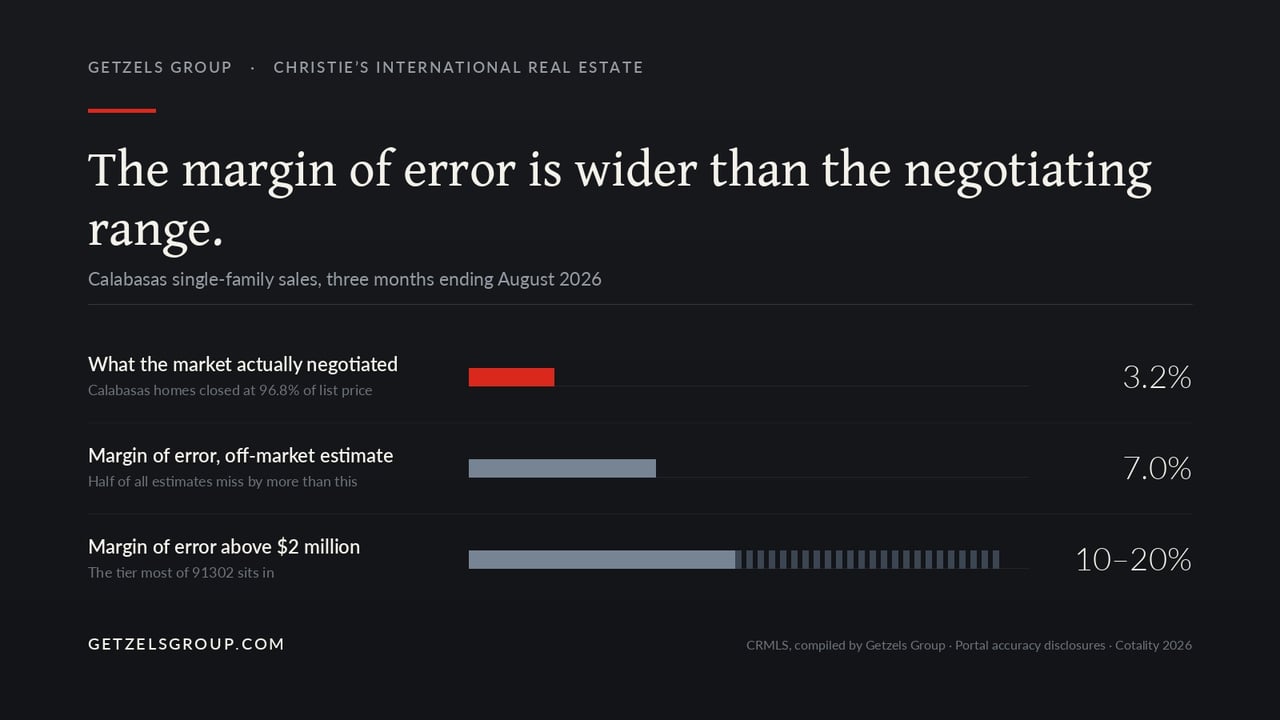
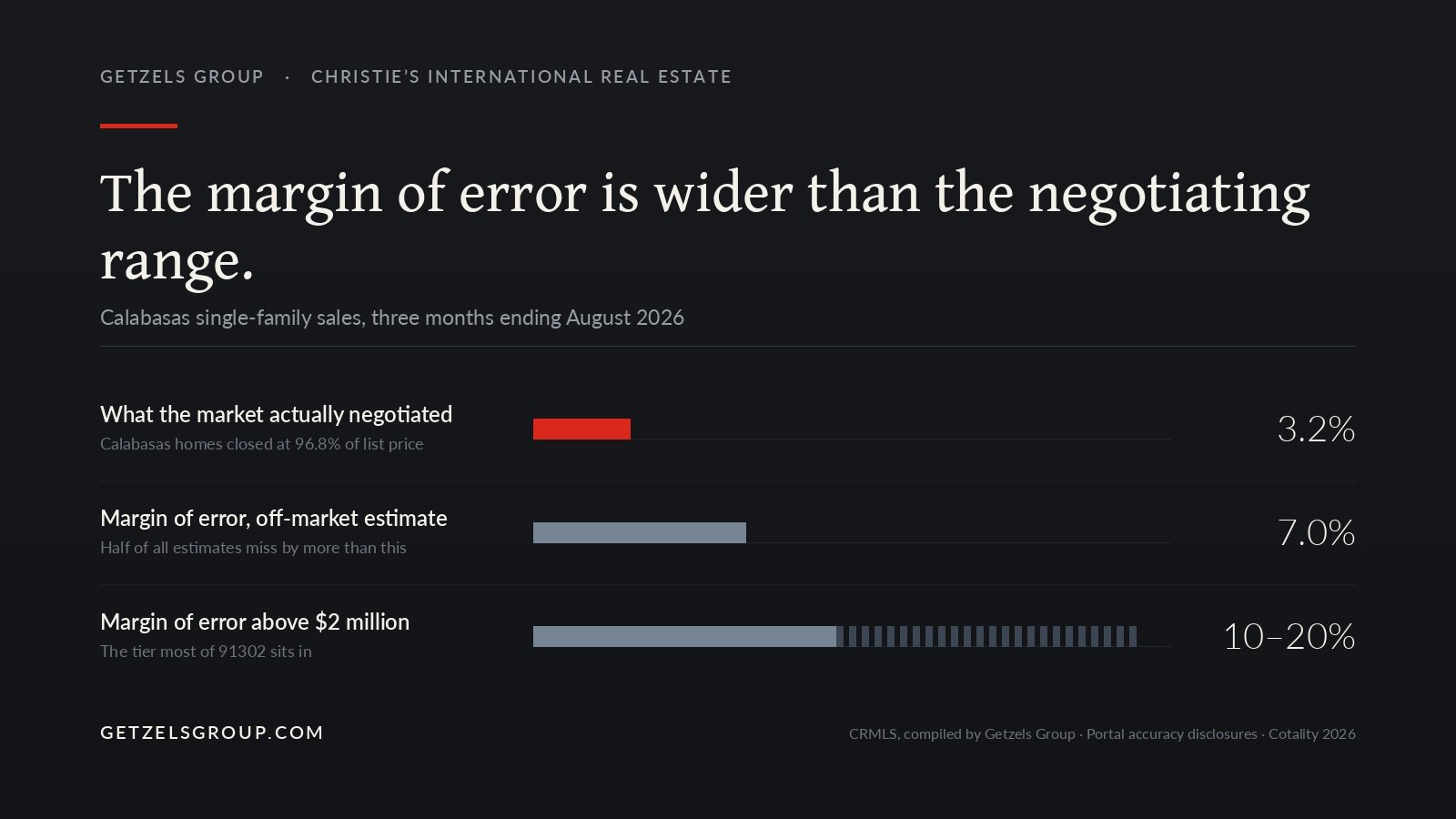
The short answer. Automated home value estimates are reasonably accurate for typical homes in active markets and unreliable for everything else. The portals’ own accuracy disclosures follow a consistent pattern: roughly 2% median error while a home is actively listed for sale, and roughly 7% when it is not. Above $2 million, independent analyses of Cotality’s 2026 housing data put automated valuation error at 10% to 20%, because comparable sales become scarce and no two estates are alike. In Calabasas, homes closed at 96.8% of list price over the three months ending August 2026 — a negotiating range of about 3%. The algorithm’s error band is wider than the entire spread you are trying to price into.
What the data shows
- The median error rate for off-market automated home value estimates is roughly 7% nationally, which means half of all estimates miss by more than 7% (Zillow published accuracy data, 2026).
- Automated valuation error rises to 10% to 20% on homes priced above $2 million, compared with 3% to 6% at median prices (CMAflow, analyzing Cotality 2026 housing data).
- The median sale price in Calabasas, California was $1,808,803 for the three months ending August 2026, up 20.8% year over year (CRMLS, compiled by Getzels Group).
- Calabasas homes sold at 96.8% of list price with a median 63 days on market and an average of three offers over the three months ending August 2026 (CRMLS).
- The median sale price in Hidden Hills, California was $6.2 million in March 2026, with a median 193 days on market and homes selling about 6% below list (CRMLS).
- Hidden Hills is a separate incorporated city but shares ZIP code 91302 with Calabasas, so a model weighting ZIP-level comparable sales blends two markets roughly 3.4 times apart in median price.
- U.S. prospective homebuyer trust in AI tools to help find a home fell to 16% in 2026 from 30% a year earlier (Cotality).
- 44% of homebuyers say they would pay more for a human professional to verify AI-generated information (NAR).
Methodology: Calabasas and Hidden Hills figures reflect closed single-family sales recorded in CRMLS for the periods stated, compiled by Getzels Group. Automated valuation accuracy figures reflect the portals’ own published disclosures and independent analyses of Cotality 2026 housing data.
Key facts at a glance
Metric | Reading | Period | Source |
|---|---|---|---|
Zestimate median error, national | Approximately 1.9% on-market, approximately 7% off-market | 2026 | Zillow published data; independent reviews |
Automated valuation error above $2 million | 10% to 20%, versus 3% to 6% at median prices | 2026 Cotality data, independent analysis | Cotality 2026 data, via CMAflow and COR Advisors |
Calabasas median sale price | $1,808,803, up 20.8% year over year | Three months ending August 2026 | CRMLS, compiled by Getzels Group |
Calabasas sale-to-list ratio and days on market | 96.8% of list, median 63 days, average 3 offers | August 2026 | CRMLS, compiled by Getzels Group |
Hidden Hills median sale price and days on market | $6.2 million, up 4.3%, median 193 days, about 6% below list | March 2026 | CRMLS, compiled by Getzels Group |
U.S. buyer trust in AI to help find a home | 16%, down from 30% the prior year | Q1 2026 survey | |
Buyers who would pay more for a human to verify AI output | 44% | 2026 |
What is an automated home value estimate?
An automated valuation model, or AVM, is a statistical program that estimates a property’s value from public records, tax assessor data, prior sales, and recent comparable transactions in the surrounding area. Zillow’s Zestimate and the competing portal home value estimates are the consumer-facing examples most Southern California homeowners have seen.
An AVM is not an appraisal and not a broker price opinion. It is a prediction generated without anyone entering the property. Zillow states this directly: the Zestimate is a computer-generated estimate, cannot be used in place of an appraisal, and its accuracy is directly affected by how much data exists for your home and for homes in your area (Zillow).
What do the portals actually claim about accuracy?
Both companies publish their own figures, and both are more candid than the way those figures get repeated at cocktail parties.
One major portal publishes a median error rate of 1.87% for on-market homes and calls its own estimate “just a starting point” — not an appraisal, not a substitute for an agent’s pricing advice, and potentially blind to renovations missing from the MLS. That same company reports off-market median error between roughly 5.6% and 7.5% depending on the update cycle. Independent reviews of Zillow’s published regional data place the national off-market Zestimate error near 7%.
Here is the part that almost never gets explained. The accurate number is the on-market number, and it is accurate in part because the home is already listed at a price the model can see. Once your home is publicly priced, the estimate drifts toward that price. If you are a homeowner quietly checking your value before you list, you are by definition in the off-market group — the less accurate one.
Why “median error” is a softer phrase than it sounds
A 7% median error does not mean estimates are off by up to 7%. It means half of them are off by more than 7%. On a $2.4 million home in 91302, half the estimates in that distribution miss by more than $168,000 — and nothing in the figure tells you which half yours is in.
Why does AI get less accurate as homes get more expensive?
Because automated models are pattern machines, and luxury inventory is exactly where the patterns run out. Analyses of Cotality’s 2026 housing data report error rates of 10% to 20% on properties above $2 million, against roughly 3% to 6% at median-market prices, per independent industry analyses of that data (CMAflow, COR Advisors).
The mechanism has been documented in valuation literature for years. AVMs generally assume a subject property is in average condition for its age, with verification limited to exterior or drive-by observation where it happens at all (Quantarium). The Royal Institution of Chartered Surveyors makes the same point about data dependency: model output is only as good as the recency, availability, and completeness of what feeds it (RICS).
In Calabasas and Hidden Hills, that becomes five specific blind spots.
1. Comparable sales run out
Hidden Hills recorded a median sale price of $6.2 million with a median 193 days on market, and multiple offers described as rare (CRMLS). A market that closes a handful of sales in a year does not give an algorithm a training set. It gives it a rumor.
2. Condition varies enormously inside one tract
Two homes on the same Calabasas street with identical recorded square footage can differ by a seven-figure margin depending on whether the kitchen dates to 2004 or 2024, whether roof and mechanical systems have been replaced, and whether the pool reads as an amenity or a liability. Public records do not carry that distinction, and neither do models built on them.
3. View, grade, and outlook are invisible
A canyon or ridgeline outlook is among the largest premiums in the Calabasas market and among the least legible to a data feed. Parcel data knows lot size. It does not know what you see from the back terrace, or which neighbor’s second story took that view away last year.
4. Gates are not interchangeable
Guard-gated, single-entry, and horse-zoned parcels carry real and distinct premiums in Calabasas and Hidden Hills, and buyers pay for the specific character of a community rather than the presence of a gate. An algorithm treats “gated” as one variable. A buyer choosing between The Oaks and The Ridge does not.
5. Off-market sales never enter the data
A meaningful share of luxury trades in Calabasas and Hidden Hills happens quietly, a strategy we cover in selling a luxury home without going public. Sales that never hit public marketing are also sales that never enter the model. The higher the price tier, the more of the real evidence is invisible to software.
Why do Calabasas and Hidden Hills confuse valuation algorithms?
Because they share a ZIP code and almost nothing else.
Hidden Hills is a separately incorporated city in Los Angeles County, entirely gated and horse-zoned, and its mailing address falls inside ZIP code 91302 — the same ZIP that covers a large share of Calabasas. Calabasas itself spans 91301 and 91302, with 91372 as a post office box ZIP.
Now put the two medians side by side. Calabasas recorded a median sale price of $1,808,803 for the three months ending August 2026. Hidden Hills recorded a median of $6.2 million in March 2026 (CRMLS). That is a spread of roughly 3.4 times inside one ZIP code.
Any model that leans on ZIP-level comparable sales is blending those two populations. The result is predictable in direction: Hidden Hills estates get pulled down toward the Calabasas median, and higher-end Calabasas homes get pulled up by estate sales they cannot compete with. If your home sits at either edge of 91302, the estimate is not slightly off. It is drawing on the wrong market.
Where valuation error concentrates in the Calabasas area
- Hidden Hills (91302) — the hardest market in the region to value automatically. A median 193 days on market and rare multiple offers (CRMLS) means very few closed sales per year for a model to learn from.
- Guard-gated Calabasas — The Oaks, The Estates at The Oaks, Mountain View Estates, The Ridge (91302) — estate tier pricing inside a city whose overall median sits near $1.81 million. Gate structure, privacy, and lot position drive premiums no public record captures.
- View and ridgeline parcels across Calabasas and Woodland Hills — outlook is one of the largest premiums here and one of the least legible to a data feed.
- Recently and heavily renovated homes anywhere in 91301 or 91302 — automated models generally assume average condition for the home’s age, so a full renovation is often invisible until it appears in the MLS.
- Homes on streets with recent off-market activity — quiet sales never enter the data, so the most relevant comparable sale on your street may be one the algorithm has never seen.
“The algorithm has never stood in the house. It does not know the kitchen is original, that the view was built out two years ago, or that a buyer has been waiting nine months for this particular street. Those three facts move the price more than square footage does.”
— Sarah G. Anderson, Getzels Group, Christie’s International Real Estate Southern California
What does this mean if you are thinking about selling?
It means the number in your head may have been set by the least reliable instrument available, and every decision downstream inherits that error.
Both directions cost money. Anchored high, you list above the market. In a market where Calabasas homes closed at 96.8% of list after a median 63 days with an average of three offers (CRMLS), the correction is not a quick trim. It is weeks of aging, then a price reduction that becomes a public signal, then a final number below where a correct launch price would have landed. Anchored low, you leave the difference on the table and never learn what it cost you.
The Los Angeles luxury market is also not behaving uniformly right now. Calabasas median sale price was up 20.8% year over year for the three months ending August 2026, while Hidden Hills was up 4.3% with average homes selling about 6% below list (CRMLS). Two adjacent markets, two different sets of physics. One national model applied across both will be wrong in a different direction in each, and it will not tell you which.
What actually sets a launch price: closed comparable sales chosen by someone who walked them, condition and finish assessed in person, the active competition and what it is currently doing, the specific buyer pool for your gate and price tier, and a read on how long real buyers have been waiting. That is the work behind our Calabasas home valuation and the seller strategy built around it.
“In Calabasas, homes closed at 96.8% of list price this summer. The market’s entire negotiating range is about three percent — narrower than the margin of error on an off-market algorithmic estimate. The number you are anchoring to can be wrong by more than the whole spread you are trying to price into.”
— Nathaniel Pitchon-Getzels, Getzels Group, Christie’s International Real Estate Southern California
Does any of this matter if you are buying?
More than most buyers realize, because the same anchor operates on the other side of the table.
Buyers now arrive pre-anchored. Cotality’s 2026 research found 55% of homebuyers use generative AI tools at least once a month, and roughly three-quarters assume AI is already involved somewhere in the homebuying process (Cotality). NAR’s reporting shows 52% of AI users turning to it specifically to research neighborhoods, market trends, or property values (NAR).
So a buyer walks into a Calabasas open house holding an estimate. If it is 12% low, they write an offer that cannot win and conclude the market is irrational. If it is 12% high, they overpay on a house whose condition discount the model never registered, and the appraisal becomes someone else’s problem at day 21. Both outcomes come from the same error: treating an estimate as a valuation. Our buyer process begins by replacing the anchor with comparable sales you can actually go inspect.
Will AI replace real estate agents?
Fair question, and the consumer data answers it more usefully than the industry argument does.
Trust is moving in the opposite direction from adoption. Cotality found that trust in AI tools to help find a home fell to 16% among U.S. prospective buyers in 2026, down 14 points from 30% a year earlier, while 68% want clear notification when AI generates a listing, price, or mortgage recommendation (Cotality). Bank of America’s homebuyer research, reported by NAR, found 44% of buyers would pay more for a human professional to verify AI-generated information, with more than half preferring a real estate professional for touring homes and for legal or contractual guidance (NAR).
People are using these tools constantly and trusting them less as they use them more. That is not a contradiction. That is what happens when you get a confident answer about the largest asset you own and then discover the model has never seen your street.
We use AI every day — for research, for drafting, for finding patterns across market data. It has made parts of this work faster and sharper. What it has not done is walk a house, read a seller’s real timeline, call the agent who has a buyer waiting, or tell you which of two nearly identical offers will still be standing on day 30. The judgment that decides your number is applied in person. That is the part that has not been automated, and it is the part we are paid for.
How to get your own estimate audited
Send us the estimate and the address. We return a written Valuation Audit: your portal home value estimate set next to a corrected range, the specific closed comparable sales we used, the condition and view adjustments the model missed, relevant off-market activity in your community, and a realistic launch range with days-on-market expectations. No obligation and no listing presentation attached.
Request your Valuation Audit →
Key takeaways
- Automated estimates are most accurate for homes already listed for sale, and least accurate for the off-market homeowners who are quietly checking their value.
- Median error near 7% off-market means half of all estimates miss by more than 7%.
- Above $2 million, independent analyses of 2026 data put automated valuation error at 10% to 20%.
- Calabasas closed at 96.8% of list over the three months ending August 2026, so the market’s own negotiating range is roughly 3% — narrower than the algorithm’s error band.
- Hidden Hills, at a $6.2 million median with a median 193 days on market, has too few closed sales for a model to learn from.
- Buyer trust in AI for home search fell to 16% in 2026 from 30%, and 44% of buyers would pay more for a human to verify AI output.
Frequently asked questions
How accurate is the Zestimate in Calabasas?
Zillow does not publish a Calabasas-specific figure, but it confirms that Zestimate accuracy depends directly on how much data exists for your home and nearby homes, and that the Zestimate is not an appraisal (Zillow). Independent reviews of Zillow’s published regional data put national off-market error near 7%, and analyses of Cotality’s 2026 housing data put error at 10% to 20% above $2 million (CMAflow). With a Calabasas median sale price near $1.81 million and a 91302 tier well above $2 million, a large share of local homes sit in the least reliable band.
Why is my Zestimate different from my neighbor’s when our houses are the same size?
Recorded square footage is one of the few variables a model knows with certainty. Condition, finish level, view, grade, privacy, and permitted versus unpermitted work are either absent from public records or assumed to be average for the home’s age (Quantarium). Two identical footprints on the same street can be a seven-figure spread.
Are other portal home value estimates more accurate than the Zestimate?
For homes currently listed the published figures are close, clustering near 1.9% median error across the major portals. The distinction that matters is not the brand. It is on-market versus off-market. If your home is not listed, both tools are working with far less signal.
Can I use an automated estimate for a refinance, trust, or divorce?
No. Both companies state their estimates are not appraisals and cannot replace one (Zillow and competing portal published disclosures). Lending, estate, trust, and dissolution matters require a licensed appraisal. A sale decision requires a broker price opinion built on inspected comparable sales.
Should I price my home off my Zestimate?
No, and the local numbers show why. Calabasas homes closed at 96.8% of list price over the three months ending August 2026 (CRMLS), so the market’s own negotiating range was roughly 3%. An off-market algorithmic error band is materially wider than that, which means the estimate can be wrong by more than the entire spread you are trying to price into.
How accurate are AI home value estimates for luxury homes over $5 million?
Least accurate of any tier. Error rises as comparable sales thin out, and independent analyses of 2026 data place error at 10% to 20% above $2 million, worsening further above that (CMAflow). Hidden Hills, with a $6.2 million median and a median 193 days on market (CRMLS), is a clear example: too few closed sales for a model to generalize from.
Will AI replace real estate agents?
Adoption is rising while trust falls. U.S. prospective buyer trust in AI to help find a home dropped to 16% in 2026 from 30% a year earlier (Cotality), and 44% of buyers say they would pay more for a human to verify AI output (NAR). The tasks being automated are research and retrieval. Inspection, judgment, negotiation, and access to buyers who never touched a portal are not.
Why do Calabasas and Hidden Hills confuse home valuation algorithms?
Hidden Hills is a separately incorporated city in Los Angeles County but shares ZIP code 91302 with Calabasas. Calabasas recorded a median sale price of $1,808,803 for the three months ending August 2026, while Hidden Hills recorded a median of $6.2 million in March 2026 (CRMLS) — a spread of roughly 3.4 times inside one ZIP code. Any model weighting ZIP-level comparable sales blends the two populations, pulling Hidden Hills estates down toward the Calabasas median and pushing higher-end Calabasas homes up toward estate sales they cannot compete with.
Who can give me an accurate home value in Calabasas or Hidden Hills?
A local listing agent who will walk the property, select comparable sales by hand, and account for condition, view, gate, and off-market activity. Nathaniel Pitchon-Getzels and Sarah G. Anderson lead Getzels Group, a Calabasas-based luxury team with Christie’s International Real Estate Southern California. You can request a written Valuation Audit or contact us directly.
Areas we cover
Getzels Group is based in Calabasas, California and represents buyers and sellers across the western San Fernando Valley, the Conejo Valley, and the surrounding Los Angeles and Ventura County luxury markets:
- Calabasas (91301, 91302) — including The Oaks, The Estates at The Oaks, Mountain View Estates, The Ridge, Calabasas Park, and Vista Pointe
- Hidden Hills (91302)
- Woodland Hills (91364, 91367)
- West Hills (91304, 91307)
- Agoura Hills, Westlake Village, Newbury Park, and Thousand Oaks
- Encino, Tarzana, and the Mulholland Corridor
For a valuation in any of these communities, request a Valuation Audit or contact us directly.
About the authors
Nathaniel Pitchon-Getzels and Sarah G. Anderson lead Getzels Group, a Calabasas-based luxury residential team affiliated with Christie’s International Real Estate Southern California in Calabasas, representing buyers and sellers in Calabasas, Hidden Hills, Woodland Hills, West Hills, and the surrounding Los Angeles and Ventura County luxury markets. More on what the Christie’s affiliation changes in a 91302 sale is here.
Market figures cited above reflect CRMLS data compiled by Getzels Group as of the periods stated and are subject to revision. Automated valuation estimates are not appraisals. Nothing in this article is an appraisal, a broker price opinion, or legal, tax, or financial advice.