
California homeowners insurance does not cover earthquake damage, and most of the protection that matters has to happen before the shaking starts. This guide covers the steps that count for a Calabasas house: what to secure, what to retrofit, how to check your lot's hazard zone, and what earthquake insurance does and does not pay. The figures come from state and federal sources, linked at the bottom.
Start with the four steps USGS recommends
The U.S. Geological Survey lists four basic steps, which it says come from the Earthquake Country Alliance, where USGS is a partner: secure your space, plan to be safe, organize disaster supplies, and minimize financial hardship by organizing important documents, strengthening your property and considering insurance. This page focuses on the steps tied to the house itself: securing it, strengthening it, and insuring it.
Secure what can fall or move
USGS describes what shaking does inside a home: light fixtures fall, refrigerators and other large items move across the floor, and bookcases and television sets topple over. Cupboard doors can fly open and let dishes shatter. The Earthquake Country Alliance asks you to walk through each room and ask what could fall, slide or be thrown, then fasten it down.
Check the water heater
California Health and Safety Code section 19211 requires existing residential water heaters to be braced, anchored or strapped to resist falling or horizontal displacement in an earthquake. The state's bracing guidelines note that in past earthquakes unsecured water heaters moved or tipped over, which led to gas line leaks, water line leaks and damaged wiring. If you cannot tell whether yours is strapped, look at it today.
Check the foundation
An Earthquake Brace + Bolt (EBB) retrofit bolts the foundation to the frame of the house. Where short "cripple walls" sit in the crawl space, it also braces them with plywood. The California Residential Mitigation Program (CRMP), which runs the program, says this helps keep a house from sliding or toppling off its foundation. EBB applies only to wood-framed houses built before 1980 with a raised foundation or crawl space.
The EBB grant
Qualified homeowners can receive up to $3,000 toward a code-compliant retrofit. Income-eligible households, at $94,480 a year or less, can apply for an additional grant of up to $7,000. The house must be in an eligible ZIP code, wood-framed, and on level ground or a slight slope. Owner-occupied homes qualify, and non-owner-occupied residences are now eligible too. Registration is open only for a limited time each year, and eligibility is set by ZIP code, so check your own ZIP on the CRMP site instead of assuming your city is covered. For crawl-space walls 4 feet or less, a contractor or homeowner can use an approved standard plan set.
Living space over the garage
CRMP also runs the Earthquake Soft-Story (ESS) program for houses with living space over the garage. The retrofit strengthens the garage walls and structure, including the walls on either side of the garage door, to help keep the rooms above from collapsing into the garage. The house must have been built before 2000, have no more than two stories, and meet the same owner, ZIP code, wood-frame and level-ground rules. The grant is up to $13,000.
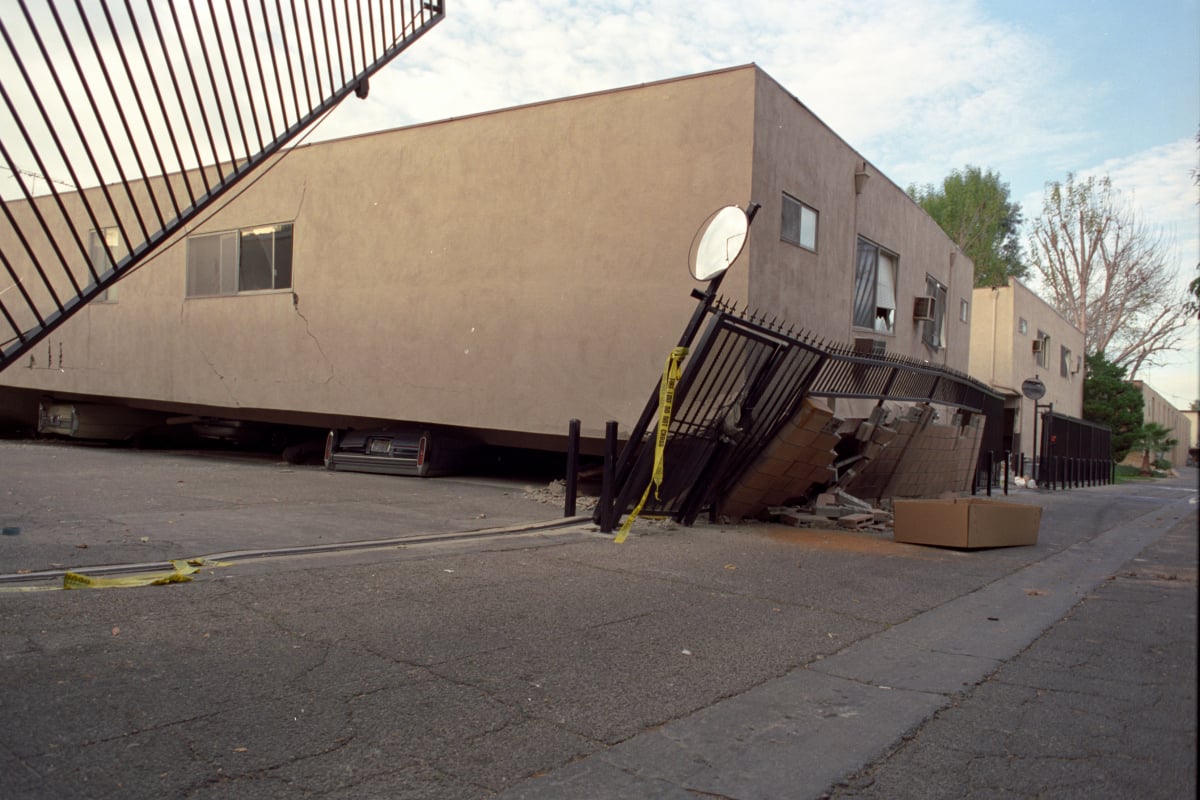
Apartment building collapsed after the January 17, 1994 Northridge earthquake. Photo: Gary B. Edstrom, public domain.
Know your lot's hazard zone
The California Geological Survey's EQ Zapp map lets you type in an address and see whether it falls inside a mapped fault, liquefaction or landslide zone. It also tells you when CGS has not yet evaluated the area. The zones mean different things:
- Alquist-Priolo earthquake fault zones cover surface fault rupture only. A structure for human occupancy cannot be placed over an active fault trace and must be a minimum distance from it, generally fifty feet.
- Seismic hazard zones mark ground where weak soil or rock may fail in an earthquake. The mapped hazards are liquefaction, earthquake-induced landslides and amplified ground shaking.
Sellers and their agents must disclose when a property sits inside a mapped zone, through the Natural Hazard Disclosure Statement. If you are buying, look up the address before you write an offer.
What earthquake insurance covers
The California Department of Insurance explains the basics in its earthquake insurance guide, revised April 25, 2024. Confirm current terms with your own insurer.
- Homeowners, renters and condominium policies do not cover earthquake damage. The exception is fire.
- Your insurer must offer earthquake coverage every other year, in writing, with the limits, deductible and premium. You have 30 days from the mailing date to accept, and not replying counts as rejecting the offer.
- The California Earthquake Authority (CEA) provides most earthquake insurance in the state. You buy it through a participating insurer, and it must be the same company that holds your residential policy.
- CEA dwelling deductibles run from 5% to 25%. The lowest available deductible is 15% if the home is valued over $1 million, or if it was built before 1980 on a raised or other non-slab foundation and has not been verified as seismically retrofitted. Ask your insurer how a verified retrofit changes your options. Deductibles are percentages, so ask for the dollar figure.
- As with most earthquake policies, CEA coverage does not include landscaping, pools, fences, masonry or separate buildings.
- Personal property limits start at $5,000 and can go to $25,000. Additional living expenses can be set from $1,500 to $100,000 and carry no deductible.
If you have a mortgage, you must carry homeowners insurance, but you do not have to buy earthquake insurance. That is a decision to make with real numbers in front of you, not by default.
Woodland Hills and Tarzana: what Northridge showed
The magnitude 6.7 Northridge earthquake struck in the early morning of January 17, 1994, and woke about 10 million people across the Los Angeles region, according to USGS. At a nursery in Tarzana, about 6 km south of the epicenter, an accelerograph recorded roughly 1.78 g of horizontal acceleration. USGS researchers noted that the instrument sat on top of a hill about 15 meters high, so that reading shows how local ground conditions can change shaking. It is not a measure of what every home in Tarzana felt.
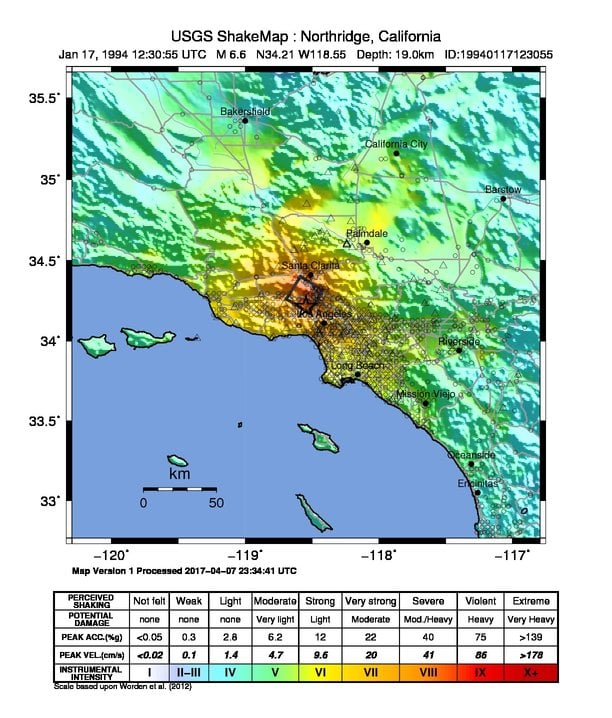
USGS ShakeMap, 1994 Northridge earthquake (public domain).
Owners in Woodland Hills and Tarzana can run the same checks: the year the house was built, the foundation type, any living space over the garage, the EQ Zapp result for the address, and the insurance offer. Read our guides to Woodland Hills and Tarzana for the neighborhoods themselves.
During the shaking
FEMA and the Earthquake Country Alliance recommend Drop, Cover and Hold On: drop to your hands and knees, cover your head and neck with your arms, and hold on to sturdy shelter until the shaking stops. Afterward, USGS advises wearing sturdy shoes because of broken glass and debris and expecting aftershocks. If you turned the gas off, do not turn it back on yourself. Let the gas company do it. Do not use matches, lighters, camp stoves, barbecues or electrical equipment until you are sure there are no gas leaks. Use the phone only for a medical or fire emergency so the lines stay open.
Calabasas questions
Does homeowners insurance cover earthquake damage in California?
No. According to the California Department of Insurance, homeowners, renters and condominium policies do not cover earthquake damage, except for fire. Earthquake coverage is a separate policy.
How much can an Earthquake Brace + Bolt grant pay?
Up to $3,000 toward a code-compliant retrofit, plus up to $7,000 more for households earning $94,480 a year or less. Registration opens for a limited time each year, so check the CRMP site for the current window.
How do I check whether my address is in an earthquake hazard zone?
Enter the address in the California Geological Survey's EQ Zapp map. It shows mapped fault, liquefaction and landslide zones, and it tells you if the area has not been evaluated.
Do I need earthquake insurance if I have a mortgage?
You must have homeowners insurance with a mortgage, but California does not require you to buy earthquake insurance.
Buying or selling in Calabasas
If you are weighing a purchase, gather the year built, the foundation type, the EQ Zapp result and an earthquake insurance quote before you write an offer. Start with our Calabasas homes for sale and the Calabasas neighborhood guide. Hillside buyers should also read the hillside home checklist. Owners preparing to sell can see our Calabasas seller page or request a home valuation.
Sources
- USGS: What can I do to be prepared for an earthquake?
- Earthquake Country Alliance: Seven Steps to Earthquake Safety
- FEMA P-1078: Protect Yourself During an Earthquake
- California Health and Safety Code section 19211
- Division of the State Architect: Guidelines for Earthquake Bracing of Residential Water Heaters
- California Residential Mitigation Program: See if you qualify
- California Geological Survey: EQ Zapp
- California Geological Survey: Alquist-Priolo Earthquake Fault Zones
- California Geological Survey: Seismic Hazard Zones
- California Department of Insurance: Earthquake Insurance
- USGS: Response to an urban earthquake, Northridge '94
- USGS: Directional topographic site response at Tarzana
Photos: Gary B. Edstrom, public domain (Wikimedia Commons). ShakeMap: USGS, public domain.